Introduction
If you’re planning to invest in meat processing equipment, one of the most common questions is whether you need a meat grinder, a bowl cutter, or both.
Although these two machines are often used in meat production, they perform completely different functions and deliver different final products.
Choosing the wrong equipment can affect product quality, texture, production efficiency, and even profitability.
In this guide, we’ll explain the differences between meat grinders and bowl cutters, compare their applications, advantages, limitations, and help you decide which machine best fits your production needs.
Quick Answer
A meat grinder is designed to grind fresh or frozen meat into coarse or fine minced meat, making it ideal for burgers, minced pork, ground beef, and fresh sausages. A bowl cutter, on the other hand, uses high-speed rotating knives to chop, mix, and emulsify meat into a smooth, uniform paste for products such as hot dogs, frankfurters, meatballs, fish balls, and premium sausages.
For most commercial sausage factories, the best solution is not choosing one over the other—but using both machines as part of the same production line.
Table of Contents
- What Is a Meat Grinder?
- What Is a Bowl Cutter?
- Meat Grinder vs Bowl Cutter: Key Differences
- Product Texture Comparison
- Can a Bowl Cutter Replace a Meat Grinder?
- Which Machine Is Best for Different Meat Products?
- Buying Guide: How to Choose the Right Machine
- Frequently Asked Questions
- Final Thoughts
What Is a Meat Grinder?
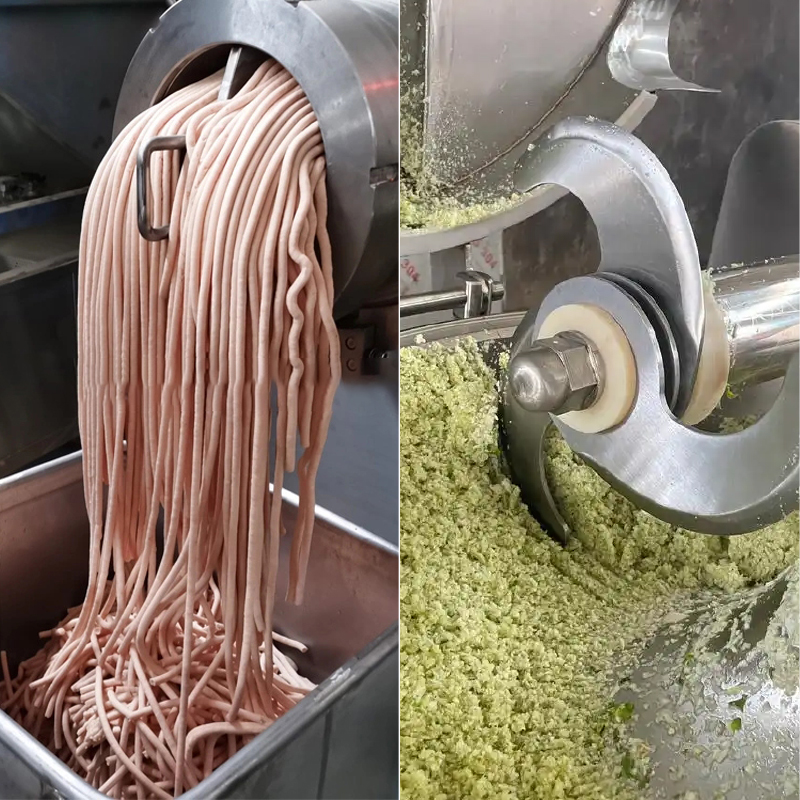
A meat grinder (also known as a meat mincer) is one of the most common machines in the meat processing industry. It is designed to reduce whole cuts of meat into uniform minced meat by forcing the material through a rotating cutting knife and perforated grinding plate.
The grinding process maintains much of the meat’s natural fiber structure while producing a consistent particle size. Depending on the grinding plate selected, manufacturers can achieve coarse, medium, or fine minced meat for different products.
Because of its simplicity, reliability, and high production efficiency, the meat grinder is widely used in butcher shops, supermarkets, restaurants, central kitchens, and industrial meat processing plants.
How Does a Meat Grinder Work?
The process is straightforward but highly efficient.
The auger continuously pushes meat toward the rotating knife, which cuts the meat against the grinding plate. The hole diameter of the plate determines the final particle size.
This mechanical process creates evenly ground meat while preserving the meat’s original texture.
Main Advantages of a Meat Grinder
High Production Efficiency
Commercial meat grinders can process hundreds or even thousands of kilograms of meat per hour, making them ideal for continuous production.
Consistent Particle Size
Different grinding plates allow manufacturers to produce coarse, medium, or fine minced meat depending on product requirements.
Simple Operation
Most commercial meat grinders feature intuitive controls and require minimal operator training.
Low Maintenance
Compared with more complex processing equipment, meat grinders have fewer moving components, making maintenance relatively easy and cost-effective.
Excellent Versatility
A commercial meat grinder can process:
- Beef
- Pork
- Chicken
- Lamb
- Fish
- Vegetables
- Frozen meat (depending on machine design)
- Pet food ingredients
Common Applications
A meat grinder is commonly used to manufacture:
- Ground beef
- Minced pork
- Burger patties
- Fresh sausages
- Meat pie fillings
- Dumpling fillings
- Meatballs (first grinding stage)
- Pet food products
For many food businesses, the meat grinder is the first machine in the production process because it prepares raw meat for further mixing, seasoning, or emulsification.
Limitations of a Meat Grinder
Although highly efficient, a meat grinder has certain limitations.
It cannot emulsify meat, extract protein efficiently, or produce the smooth texture required for premium processed meat products.
For products such as hot dogs, frankfurters, bologna, fish balls, and premium sausages, grinding alone is not enough.
This is where the bowl cutter becomes essential.
What Is a Bowl Cutter?
A bowl cutter, sometimes called a bowl chopper, is a high-speed processing machine designed to chop, mix, blend, and emulsify meat into a fine, homogeneous paste.
Unlike a meat grinder, which simply reduces meat into smaller particles, a bowl cutter performs several processing functions simultaneously.
It chops meat with multiple high-speed knives while rotating the stainless-steel bowl, allowing ingredients such as salt, spices, starch, water, and ice to be mixed evenly throughout the product.
This process extracts myofibrillar proteins from the meat, creating a stable emulsion that gives processed meat products their characteristic elasticity, smooth texture, and excellent binding properties.
For manufacturers producing high-quality sausages or emulsified meat products, the bowl cutter is one of the most important pieces of equipment in the production line.
How Does a Bowl Cutter Work?
The operating principle differs significantly from a meat grinder.
The bowl rotates continuously while multiple knives spin at extremely high speeds.
During this process, ingredients are evenly distributed and meat proteins are released, producing a smooth, stable mixture suitable for premium processed meat products.
Some advanced bowl cutters also operate under vacuum conditions to improve product quality by reducing air bubbles and oxidation.
Main Advantages of a Bowl Cutter
Superior Product Texture
High-speed chopping creates an exceptionally smooth and uniform meat paste.
This is essential for premium sausage manufacturing.
Excellent Mixing Performance
Seasonings, spices, additives, starch, and water are thoroughly blended during processing, ensuring consistent flavor and quality.
Better Protein Extraction
Efficient protein extraction improves:
- Water retention
- Elasticity
- Product firmness
- Sliceability
- Final yield
Higher Product Quality
Because ingredients are mixed more evenly, bowl cutters help manufacturers produce products with consistent appearance, taste, and texture.
Suitable for Multiple Food Industries
Besides meat processing, bowl cutters are widely used for:
- Fish paste
- Seafood products
- Vegetable fillings
- Pet food
- Cheese processing
- Ready meals
- Plant-based protein products
Common Applications
Commercial bowl cutters are commonly used to produce:
- Hot dogs
- Frankfurters
- Bologna
- Emulsified sausages
- Fish balls
- Beef balls
- Chicken balls
- Surimi products
- Ham
- Luncheon meat
- Pet food
- Seafood paste
These products require an extremely fine texture that cannot be achieved using a meat grinder alone.
KONEX Expert Insight
One of the most common misconceptions among first-time buyers is believing that a bowl cutter can completely replace a meat grinder. In reality, these two machines are designed for different processing stages. A meat grinder efficiently reduces whole meat into uniform particles, while a bowl cutter refines that ground meat into a smooth emulsion. In most commercial sausage and processed meat production lines, using both machines together delivers the best product quality, higher production efficiency, and more consistent results.
Meat Grinder vs Bowl Cutter: Side-by-Side Comparison
Although both machines process meat, they are designed for completely different production purposes. Understanding their differences is essential before investing in equipment.
| Feature | Meat Grinder | Bowl Cutter |
|---|---|---|
| Primary Function | Grinds meat into uniform particles | Chops, mixes, and emulsifies meat |
| Processing Method | Auger, knife, and grinding plate | High-speed rotating knives and bowl |
| Final Texture | Coarse to fine minced meat | Smooth, homogeneous meat paste |
| Mixing Capability | Limited | Excellent |
| Protein Extraction | Minimal | High |
| Suitable Products | Ground meat, burgers, fresh sausage | Hot dogs, frankfurters, meatballs, bologna, fish balls |
| Ingredient Blending | Requires separate mixer | Integrated during processing |
| Investment Cost | Lower | Higher |
| Maintenance | Simple | Moderate |
| Typical Production Stage | Primary processing | Secondary/fine processing |
Which Machine Produces Better Texture?
Texture is one of the biggest differences between these two machines.
A meat grinder cuts meat into particles while preserving most of the muscle fiber structure. The result is a coarse, natural texture that is ideal for products where visible meat particles are desired, such as burgers, minced beef, fresh sausages, and dumpling fillings.
A bowl cutter, however, breaks down meat fibers at high speed while simultaneously extracting proteins and mixing ingredients. This creates a smooth, elastic emulsion with excellent binding properties—essential for premium processed meat products.
Texture Comparison
| Product Characteristic | Meat Grinder | Bowl Cutter |
|---|---|---|
| Visible Meat Fibers | ✔ | ✘ |
| Fine Emulsion | ✘ | ✔ |
| Elastic Texture | Limited | Excellent |
| Water Retention | Moderate | Excellent |
| Uniform Appearance | Good | Excellent |
| Premium Product Quality | Moderate | High |
If your customers expect a smooth bite, glossy appearance, and consistent slicing performance, a bowl cutter is the better choice.
Can a Bowl Cutter Replace a Meat Grinder?
This is one of the most frequently asked questions from new buyers.
The short answer is: No.
Although a bowl cutter is capable of reducing meat into a finer consistency, it is not designed to efficiently process large chunks of raw meat.
Grinding meat before bowl cutting provides several important advantages:
- Reduces processing time.
- Improves chopping efficiency.
- Produces a more consistent emulsion.
- Reduces knife wear.
- Extends equipment lifespan.
- Improves final product quality.
For commercial sausage production, the standard process is:
This workflow is used by most professional meat processing factories because each machine performs a specialized function.
Which Machine Is Best for Different Meat Products?
Different meat products require different processing methods.
| Product | Recommended Equipment |
|---|---|
| Ground Beef | Meat Grinder |
| Minced Pork | Meat Grinder |
| Burger Patties | Meat Grinder |
| Fresh Sausages | Meat Grinder |
| Italian Sausage | Meat Grinder + Bowl Cutter (optional depending on recipe) |
| Frankfurters | Meat Grinder + Bowl Cutter |
| Hot Dogs | Meat Grinder + Bowl Cutter |
| Bologna | Meat Grinder + Bowl Cutter |
| Meatballs | Meat Grinder + Bowl Cutter |
| Fish Balls | Bowl Cutter |
| Surimi | Bowl Cutter |
| Pet Food | Meat Grinder or Bowl Cutter depending on texture requirements |
Recommendation by Business Type
Butcher Shops
A commercial meat grinder is usually sufficient for daily production of minced meat and burgers.
Restaurants & Central Kitchens
A meat grinder is ideal for preparing fresh ingredients, while a bowl cutter becomes valuable when producing meatballs, fillings, or specialty processed products.
Sausage Manufacturers
Using both machines together delivers the highest efficiency and product consistency.
Industrial Meat Processing Plants
Complete production lines typically include a grinder, bowl cutter, vacuum mixer, stuffer, smokehouse, and packaging equipment.
Buying Guide: How to Choose the Right Machine
Before purchasing equipment, consider the following factors.
1. Your Product Range
Ask yourself:
- Do you mainly sell fresh minced meat?
- Are you producing premium sausages?
- Will you manufacture meatballs or fish balls?
- Do you plan to expand into processed meat products?
Your product portfolio should determine your equipment selection.
2. Production Capacity
Small businesses may only require a compact grinder.
Larger factories should select equipment based on hourly output and future expansion plans.
Buying equipment with room for growth often reduces long-term investment costs.
3. Product Quality Requirements
If product appearance, texture, and consistency are critical, investing in a bowl cutter is worthwhile.
Premium meat products rely heavily on proper emulsification.
4. Ease of Cleaning
Choose machines with:
- Food-grade stainless steel construction
- Smooth, hygienic surfaces
- Easy-to-remove components
- Tool-free cleaning where possible
These features reduce downtime and improve food safety.
5. After-Sales Support
Reliable technical support and spare parts availability are just as important as machine performance.
When evaluating suppliers, consider:
- Installation support
- Operator training
- Spare parts inventory
- Warranty coverage
- Technical service response time
Common Buying Mistakes
Many first-time buyers make avoidable mistakes when selecting meat processing equipment.
Mistake 1: Assuming One Machine Can Do Everything
Each machine has a specific role in the production process. Expecting one machine to perform all functions often leads to disappointing results.
Mistake 2: Buying Based Only on Price
The cheapest machine may increase maintenance costs, reduce productivity, and shorten equipment life.
Consider total cost of ownership rather than purchase price alone.
Mistake 3: Ignoring Future Expansion
Production capacity often increases as a business grows.
Selecting scalable equipment helps avoid costly upgrades later.
Frequently Asked Questions
1. Can a bowl cutter grind meat?
It can chop meat into a fine paste, but it is not designed to efficiently process large pieces of raw meat like a grinder.
2. Is a meat grinder enough for making sausages?
For fresh sausages, yes. For emulsified sausages such as hot dogs and frankfurters, a bowl cutter is also required.
3. Which machine is better for meatballs?
For premium meatballs with a smooth and elastic texture, using both a meat grinder and a bowl cutter provides the best results.
4. Can these machines process frozen meat?
Some heavy-duty meat grinders are designed for frozen meat, while most bowl cutters perform best with chilled or pre-ground meat. Always check the manufacturer’s specifications.
5. Which machine is easier to maintain?
A meat grinder generally requires less maintenance because it has a simpler mechanical structure.
6. Which machine is more expensive?
Bowl cutters typically require a higher initial investment due to their advanced chopping and mixing technology.
7. Do I need both machines for a sausage factory?
Yes. Most commercial sausage production lines use both machines to achieve consistent quality and efficient production.
8. How do I choose the right machine capacity?
Estimate your daily production volume, allow room for future growth, and select equipment that can comfortably meet peak demand.
Final Thoughts
While meat grinders and bowl cutters may appear similar at first glance, they serve distinct roles in meat processing.
A meat grinder is the best choice for producing minced meat, burger patties, and fresh sausages, offering high efficiency and reliable performance for primary processing.
A bowl cutter is essential for manufacturing premium processed meat products that require a smooth texture, strong protein binding, and consistent emulsification.
For businesses producing a wide range of meat products, these two machines are not competitors—they are complementary pieces of equipment that work together to achieve superior quality and production efficiency.
Choosing the right combination depends on your products, production capacity, and long-term business goals.
About KONEX
KONEX specializes in commercial food processing equipment and complete food processing solutions for meat, vegetables, fruits, and central kitchens.
From standalone machines to fully integrated production lines, our team helps food manufacturers improve efficiency, maintain product quality, and optimize production through reliable equipment and professional engineering support.
Whether you’re planning a new meat processing facility or upgrading an existing production line, KONEX can provide tailored solutions to match your specific processing requirements.