How a Digital Central Control IIoT System Transforms Food Processing Production Lines
Modern food processing plants are increasingly moving from independently operated machines toward connected, data-driven production systems.
On a traditional production line, each machine usually has its own control panel. Operators must walk between different processing stages to start equipment, adjust operating parameters, check machine status and identify faults. Production data is often recorded manually—or not recorded at all—making it difficult for managers to understand what is happening across the entire production line.
A Digital Central Control IIoT System changes this operating model by connecting machines, sensors, motors, instruments and control components through a unified digital platform.
Instead of managing individual machines separately, operators can monitor and coordinate the entire production process from a central interface. Production managers can access real-time information, review historical data and respond to abnormal operating conditions more efficiently.
This article explains how a Digital Central Control IIoT System works, what production challenges it can solve and how it supports the digital transformation of food processing plants and central kitchens.
What Is a Digital Central Control IIoT System?
A Digital Central Control IIoT System is an integrated industrial platform designed to connect and coordinate production equipment using Industrial Internet of Things technology.
It functions as both a digital brain and a networked nervous system for the production line.
The system connects field equipment—including food processing machines, motors, sensors, switches, instruments and environmental monitoring devices—to a centralized control and data platform. It can then collect equipment information, display production status, control operating parameters and coordinate multiple machines.
In practical terms, the system enables users to:
- Monitor the entire production line from one platform
- Start or stop connected equipment centrally
- Adjust operating parameters through an HMI touchscreen
- Collect real-time production and equipment data
- Receive fault alarms and abnormal-condition warnings
- Review historical operating trends and reports
- Access production information remotely
- Support remote commissioning and system maintenance
- Store recipes for different products and processes
- Coordinate the operation of multiple machines
The objective is not simply to connect machines to the internet. The real value lies in transforming separate pieces of equipment into a visible, coordinated and manageable production system.
Why Are Traditional Production Lines Difficult to Manage?
Many food processing plants expand gradually. A company may initially purchase one vegetable cutting machine, washing machine or conveyor and later add more equipment as production increases.
Although each machine can operate effectively on its own, the complete production line may lack unified control and data communication.
This creates several common challenges.
Disconnected Machine Controls
Each machine has its own buttons, switches and parameter settings. Operators must control equipment individually, increasing the number of manual operations required during production.
Frequent Movement Along the Production Line
When conveyor speeds, cutting parameters or washing settings need to be adjusted, operators may have to move repeatedly between machines.
This is especially inefficient on long vegetable processing, meat processing or central kitchen production lines.
Slow Fault Identification
When a production line stops, maintenance personnel may need to inspect each machine separately to determine where the fault occurred.
In some cases, the time spent identifying the problem can be longer than the time required to correct it.
Limited Production Visibility
Without centralized data collection, managers may not have an accurate overview of:
- Equipment operating status
- Production output
- Operating speed
- Energy consumption
- Equipment downtime
- Fault frequency
- Process performance
This makes it difficult to evaluate production efficiency or identify opportunities for improvement.
Dependence on Operator Experience
When production parameters are adjusted manually, processing consistency may depend heavily on the experience of individual operators.
Changes in personnel, products or production schedules can therefore affect operating stability.
The Four-Layer Architecture of a Digital Central Control System
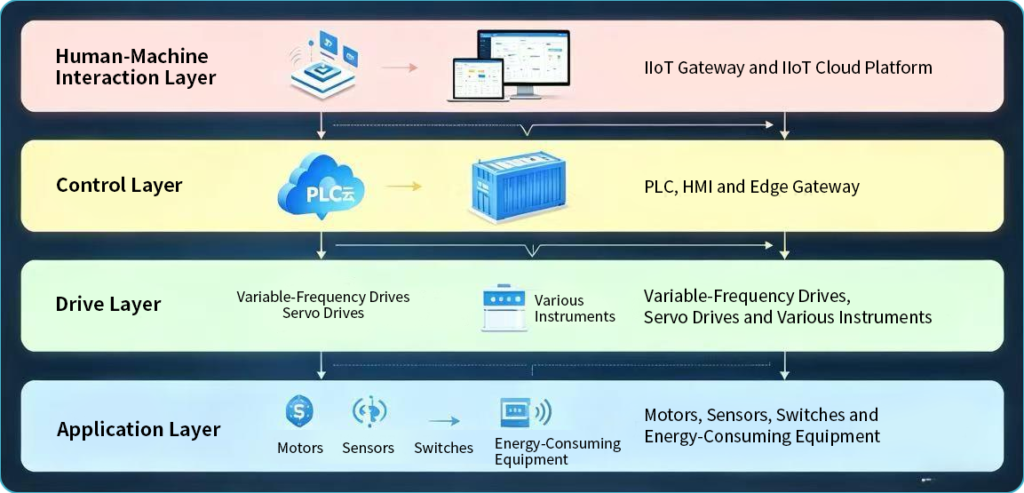
A Digital Central Control IIoT System generally consists of four interconnected layers.
1. Application Layer
The application layer includes the physical field devices used in production, such as:
- Food processing machines
- Motors
- Sensors
- Switches
- Valves
- Measuring instruments
- Energy-consuming equipment
- Environmental monitoring devices
These components perform the actual washing, cutting, conveying, sorting, dewatering, processing or packaging operations.
2. Drive Layer
The drive layer converts control commands into physical machine actions.
It may include:
- Variable-frequency drives
- Servo drives
- Precision actuators
- Motor control components
- Process instruments
For example, a variable-frequency drive can regulate conveyor speed, while a servo drive can control a process requiring more precise movement or positioning.
3. Control Layer
The control layer is responsible for logic control, data processing and communication between field devices and the digital platform.
Typical components include:
- Programmable logic controllers
- Industrial gateways
- Communication modules
- Local control systems
- Data acquisition units
The PLC receives signals from sensors, executes programmed control logic and sends operating commands to machines and drives.
Industrial gateways collect and transmit information between different devices and higher-level digital platforms.
4. Human-Machine Interaction Layer
The human-machine interaction layer provides the visual interface through which operators and managers access the system.
Depending on the project configuration, it may include:
- Industrial HMI touchscreens
- Central control room displays
- Desktop computers
- Mobile devices
- IIoT cloud platforms
This layer transforms raw machine signals into understandable information such as production status, alarm messages, operating trends and process-flow graphics.
From a “Forest of Buttons” to One Intelligent Interface
Traditional control panels often contain numerous physical buttons, indicator lights and separate instruments. Although functional, these panels usually provide limited production visibility and cannot easily display historical information.
A digital HMI interface consolidates the most important production functions into one screen.
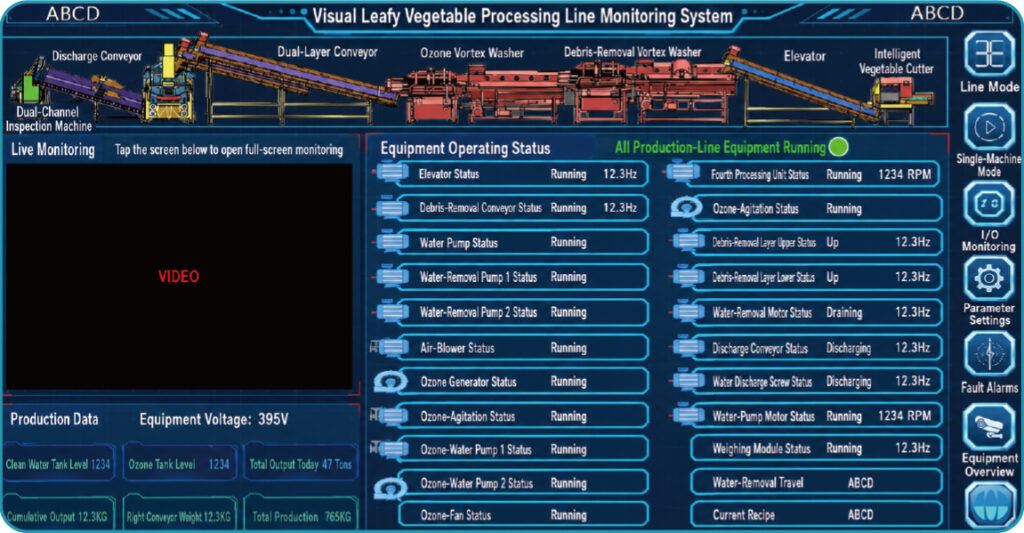
Operators can view the complete process flow, identify which machines are running and monitor operating parameters in real time.
Depending on system permissions and project requirements, the interface can support:
- One-touch production line start and stop
- Individual machine control
- Local and remote operating modes
- Parameter adjustment
- Real-time equipment status
- Alarm display and fault location
- Production output monitoring
- Energy consumption monitoring
- Historical trend analysis
- Data reports
- Equipment information management
This reduces the complexity of routine operations while giving production managers a more complete view of the factory.
Key Functions of a Digital Central Control IIoT System
Centralized Production Line Control
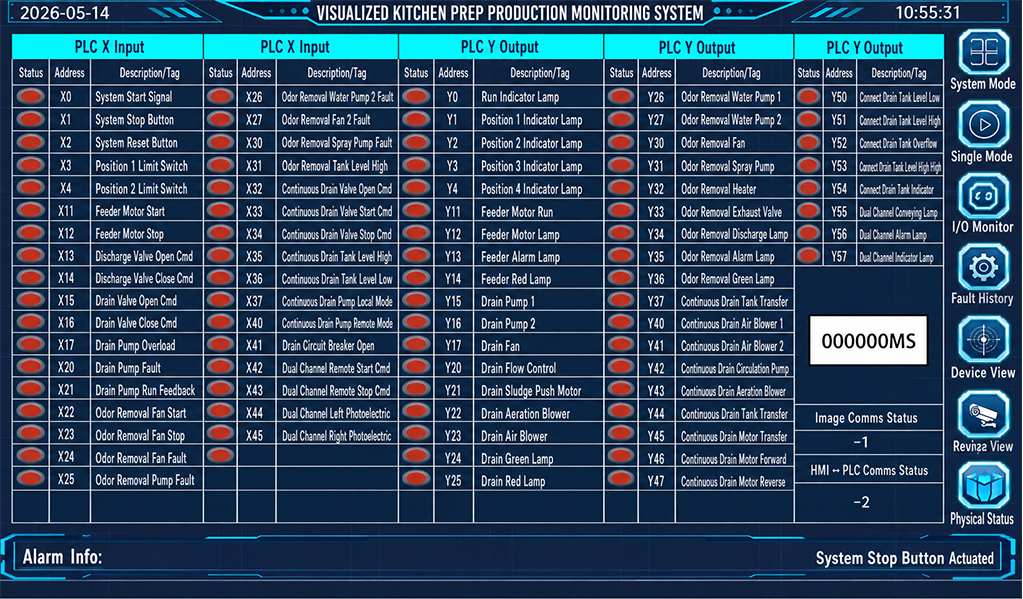
The system coordinates multiple machines from one platform, allowing different production stages to operate as a connected process rather than as isolated units.
Centralized control is especially valuable for complete food processing lines involving washing, cutting, conveying, sorting, dewatering and packaging equipment.
Real-Time Data Acquisition
The platform continuously collects data from connected equipment and field devices.
The available information may include:
- Equipment power status
- Local or remote operating mode
- Running and standby conditions
- Production output
- Process parameters
- Fault information
- Motor operating status
- Energy consumption
- Sensor signals
Real-time data helps production managers identify changes as they occur instead of relying only on manual records or end-of-shift reports.
One-Touch Recipe Changeover
Different food products may require different conveyor speeds, washing times, cutting settings or processing sequences.
A recipe-management function stores predefined process parameters for specific materials or products. When changing production, operators can select the required recipe instead of adjusting every machine individually.
This can shorten product changeover time, reduce parameter-setting errors and improve processing consistency.
Comprehensive Signal Monitoring
The system can monitor signals ranging from high-power motors to small switches and sensors.
Centralized signal monitoring provides maintenance personnel with a clearer understanding of machine health. It also helps identify whether a problem originates from a motor, sensor, switch, communication point or another component.
Automatic Alarms and Fault Location
When an abnormal operating condition occurs, the system generates an alarm and identifies the affected equipment or signal point.
This allows operators to locate problems more quickly than inspecting individual machines one by one.
Threshold alarms can also provide early warnings when a monitored value moves outside its predefined operating range.
Online Fault Diagnosis
Digital systems can connect alarm information with operating manuals, fault codes and troubleshooting guidance.
For example, operators can scan a QR code to access the relevant equipment manual or fault-handling instructions. Common issues can therefore be addressed more efficiently without repeatedly searching through printed documents.
Remote Production Monitoring
Authorized users can access production information through a computer or mobile device, depending on the system configuration and network environment.
Remote access enables managers to review equipment status and production conditions even when they are not physically present on the production floor.
Proactive Fault Notifications
When an equipment abnormality occurs, the platform can send notifications to designated users or after-sales personnel.
This supports faster communication between operators, maintenance teams and equipment suppliers.
Remote Maintenance and System Upgrades
Some commissioning, program modification and diagnostic tasks can be performed remotely.
When properly configured, remote technical support reduces the need for on-site service visits and can shorten the time required to resolve software, parameter or control-related issues.
Benefits for Food Processing Plants
Improved Operating Efficiency
Centralized parameter adjustment and one-touch line control reduce repetitive manual operations. Operators can spend more time supervising the process and less time moving between individual control panels.
Faster Troubleshooting
Automatic alarms and fault location allow maintenance teams to identify the affected machine or signal point more quickly, helping reduce unnecessary production downtime.
Greater Production Transparency
Real-time dashboards make operating speed, production output, machine status and energy information visible.
Management decisions can therefore be based on actual production data rather than estimates.
More Consistent Processing
Stored recipes and standardized parameters reduce dependence on manual adjustments. This helps maintain more consistent operating conditions across different production shifts and operators.
Better Maintenance Planning
Historical alarm records and equipment data can reveal recurring faults or changing operating patterns.
This information can support preventive and predictive maintenance planning.
Lower Operating and Service Costs
Centralized control can reduce unnecessary operator movement, simplify equipment management and improve maintenance efficiency.
Remote diagnosis and commissioning may also reduce the frequency and cost of on-site technical service.
A Foundation for Future Digitalization
Once equipment data is collected through a unified platform, the factory has a stronger foundation for further digital development.
Depending on project requirements, the central control platform can potentially connect with higher-level production management, quality control, traceability or enterprise management systems.
Industrial Hardware and Communication Foundation
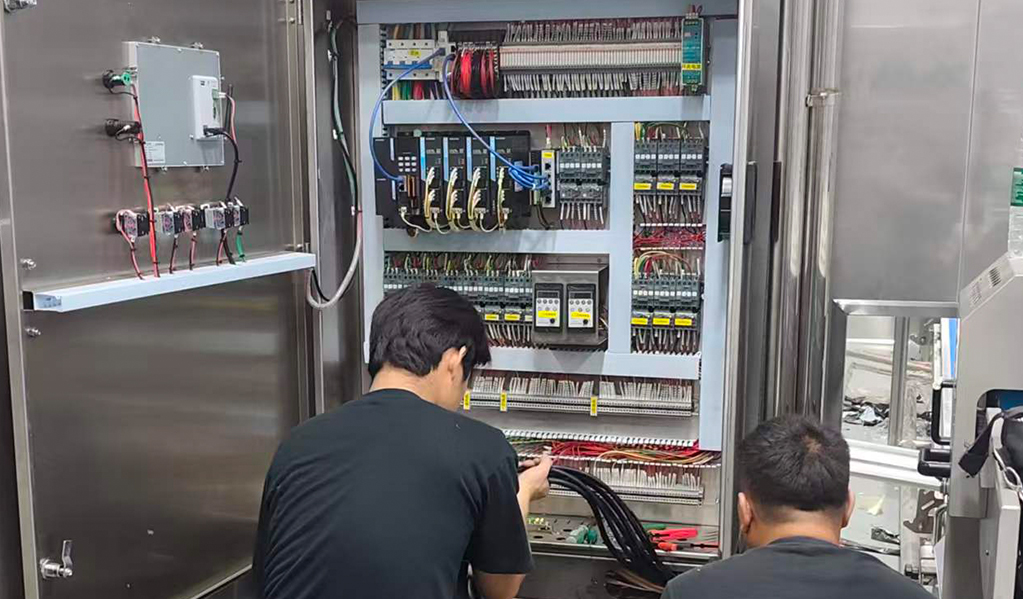
A digital production system must be built on reliable industrial hardware.
Depending on project requirements, the KONEX Digital Central Control IIoT System can incorporate PLC and control technologies from established industrial automation brands such as Siemens, Inovance and Schneider Electric.
Supported industrial communication protocols may include:
- Modbus
- TCP/IP
- CANopen
Data acquisition can be implemented through industrial HMI and IIoT platforms such as MCGS or Inovance systems.
For projects requiring greater communication reliability, a dual-network redundancy design can be used to reduce the risk of data interruption.
The final hardware configuration should be selected according to the number of machines, control complexity, network environment, production requirements and future expansion plans.
Where Can a Digital Central Control IIoT System Be Applied?
A Digital Central Control IIoT System can be configured for a wide range of food production environments, including:
- Central kitchens
- Fresh-cut vegetable processing plants
- Fruit and vegetable washing lines
- Meat processing facilities
- Ready-meal factories
- School meal production centers
- Catering supply facilities
- Food distribution centers
- Automated conveying and processing lines
- Multi-stage washing, cutting and packaging projects
The system is particularly valuable when a production line contains multiple machines that must operate in a coordinated sequence.
What Should Be Considered Before Implementation?
Digitalization should begin with a clear understanding of the production process—not simply with the installation of screens and network components.
Before designing the system, the project team should evaluate the following questions:
- Which machines need to be connected?
- What production data needs to be collected?
- Which parameters should operators be allowed to change?
- Does the production line require recipe management?
- Which alarms and operating thresholds are important?
- Who needs local or remote access?
- What user permissions and cybersecurity controls are required?
- Will the production line be expanded in the future?
- Does the system need to communicate with other management platforms?
- What level of network redundancy is necessary?
Equipment selection, electrical design, control logic, communication protocols and interface design should all be planned as part of one integrated production system.
Conclusion
The value of a Digital Central Control IIoT System goes far beyond replacing physical buttons with a touchscreen.
Its real purpose is to connect equipment, centralize operations and convert production signals into usable information.
For food processing plants and central kitchens, this can deliver:
- Clearer production visibility
- Faster operating adjustments
- More efficient fault diagnosis
- Better equipment coordination
- More consistent processing parameters
- Improved maintenance management
- Easier remote technical support
As food production becomes more automated, companies need systems that can manage the complete processing line—not just individual machines.
By combining industrial control, real-time data acquisition, visual management and IIoT connectivity, a Digital Central Control IIoT System provides an important foundation for building a more transparent, efficient and intelligent food processing facility.
Build a Smarter Food Processing Line with KONEX
KONEX provides food processing equipment, complete production line design and Digital Central Control IIoT integration.
Whether you are planning a new food processing facility or upgrading an existing production line, our team can evaluate your processing workflow, equipment configuration and automation requirements to develop a suitable centralized control solution.
Contact KONEX to discuss your food processing automation project.
Website: www.konexmachine.com
Email: info@konexmachine.com
Tel/WhatsApp: +86 181 2272 5571