As automation continues to transform the food processing industry, safety is becoming more than just a compliance requirement—it is a key factor in equipment selection.
For decades, industrial bone saws have been indispensable in meat processing plants, central kitchens, supermarkets, and food manufacturing facilities. While these machines provide the cutting power needed for high-volume production, they also present one of the highest risks of operator injury if not used correctly.
Today, advances in intelligent sensing technology are redefining what users expect from industrial cutting equipment.
Beyond Traditional Machine Safety
Conventional safety measures remain essential. Fixed guards, emergency stop buttons, operator training, standard operating procedures, and personal protective equipment (PPE) continue to form the foundation of workplace safety.
However, these measures are largely reactive—they help reduce risk but cannot always prevent accidents caused by human error or unexpected situations.
This is where intelligent safety technology introduces a new layer of protection.
Rather than responding after contact occurs, advanced detection systems are designed to recognize potential danger before an accident happens.
A New Approach: Detecting Risk Before Contact
One recent safety demonstration illustrates this concept well.
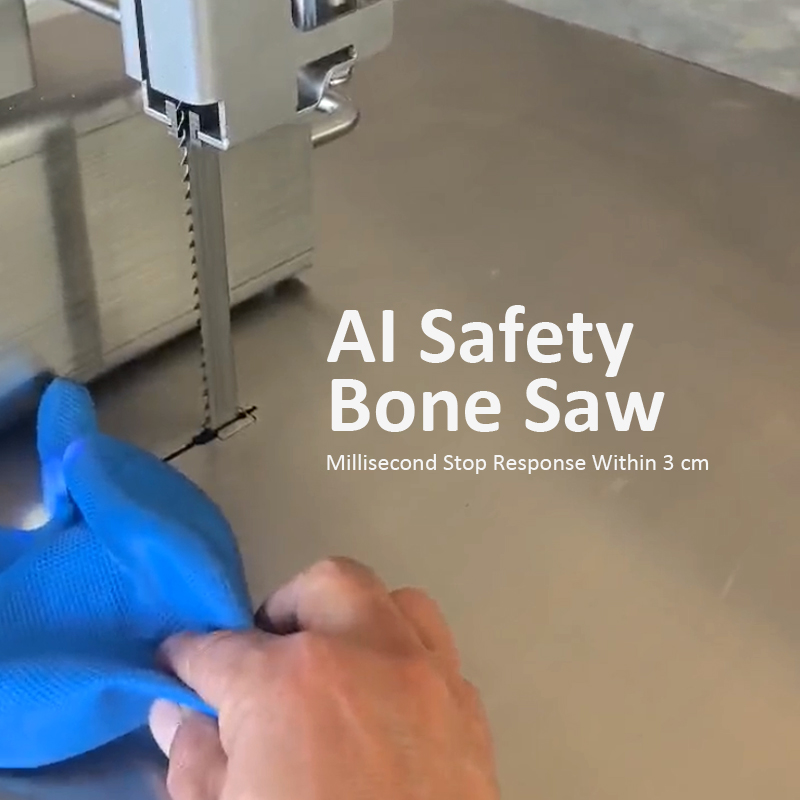
During the test, a blue glove was used to simulate an operator’s hand approaching a running bone saw blade. Once the glove entered the detection zone—approximately 3 cm (1.2 inches) from the blade—the system immediately stopped the saw within milliseconds.
Instead of waiting for physical contact, the machine proactively identified a potential hazard and interrupted operation almost instantly.
While demonstrations cannot replace real-world validation, they highlight an important shift in industrial safety philosophy: preventing accidents rather than simply minimizing their consequences.
Why It Matters for Meat Processing Operations
In meat processing facilities, production lines operate under demanding conditions.
Operators often work with:
- Frozen meat
- Bone-in products
- Repetitive cutting tasks
- Wet environments
- Cold temperatures
- High production speeds
These conditions increase both operational complexity and the likelihood of accidental mistakes.
Even experienced workers can become fatigued during long production shifts.
An intelligent rapid-stop system cannot eliminate every risk, but it may significantly reduce the potential severity of accidental incidents by providing an additional level of protection.
Important Questions Buyers Should Ask
As AI-assisted safety systems become more common, purchasing decisions should be based on practical performance rather than marketing claims.
Food manufacturers should evaluate several key factors before investing.
1. Detection Accuracy
Can the system reliably distinguish between human hands, protective gloves, meat products, and processing tools?
False triggers may reduce productivity, while missed detections could compromise safety.
2. Performance in Real Production Environments
Industrial meat processing presents challenging conditions, including moisture, low temperatures, blood, fat, and continuous operation.
A safety system should maintain stable performance under these demanding circumstances.
3. Response Speed
Milliseconds matter.
The faster the machine detects risk and stops blade movement, the greater the opportunity to prevent injury.
Manufacturers should provide measurable response-time data supported by testing.
4. Maintenance Requirements
Intelligent systems require routine inspection and calibration.
Processors should understand:
- Maintenance intervals
- Sensor cleaning procedures
- Diagnostic functions
- Replacement schedules
Reliable long-term performance depends on proper maintenance.
5. Impact on Productivity
Safety improvements should not come at the expense of production efficiency.
The ideal solution integrates advanced protection while maintaining high throughput and minimizing unnecessary interruptions.
Intelligent Safety Is Not a Replacement for Good Practice
It is important to recognize that intelligent safety technology should never replace established workplace safety measures.
Operators still require:
- Professional training
- Correct operating procedures
- Appropriate PPE
- Regular equipment maintenance
- Compliance with local safety regulations
Instead, intelligent detection should be viewed as an additional layer within a comprehensive safety strategy.
The strongest safety culture combines responsible operators, well-designed equipment, and advanced protective technologies.
The Future of Industrial Bone Saws
The food processing industry has already embraced automation in washing, cutting, packaging, and inspection.
Safety is following the same path.
As sensors become more accurate, AI algorithms continue to improve, and machine control systems become faster, intelligent safety functions are likely to become increasingly common in industrial cutting equipment.
In the coming years, buyers may evaluate bone saws not only by cutting capacity, blade performance, or energy efficiency, but also by how effectively they protect operators while maintaining production performance.
Final Thoughts
Intelligent rapid-stop technology represents an exciting development in industrial food processing equipment.
While it should never replace proper guarding, operator training, or established safety procedures, it has the potential to significantly strengthen workplace protection when implemented correctly.
For equipment manufacturers, the challenge is to develop systems that are reliable, practical, and thoroughly validated.
For food processors, the opportunity lies in selecting equipment that balances productivity, reliability, and operator safety.
As intelligent safety technology continues to evolve, one question is becoming increasingly relevant:
Could advanced safety systems become the new standard for industrial bone saws?
I recently reviewed a safety demonstration in which a blue glove was used to simulate an operator’s hand approaching a running saw blade. When the glove entered the detection zone—approximately 3 cm from the blade—the machine stopped within milliseconds.